Skip to main contentGet help now
Iris Mental Health Consultancy CIC
Get started

Research

What our community told us about mental health support.

In July 2026 we asked people in our community about their experience of mental health support: what gets in the way, whether they know what’s available, and how easy it is to get help when they need it. Around 28 people, mostly in England, shared their views.

We did this because we want our services to be shaped by the people they are for. This page explains what they told us in plain words, and why it matters. The full numbers are at the bottom of the page.

What we found

Five things people told us.

#1

Waiting is the biggest barrier.

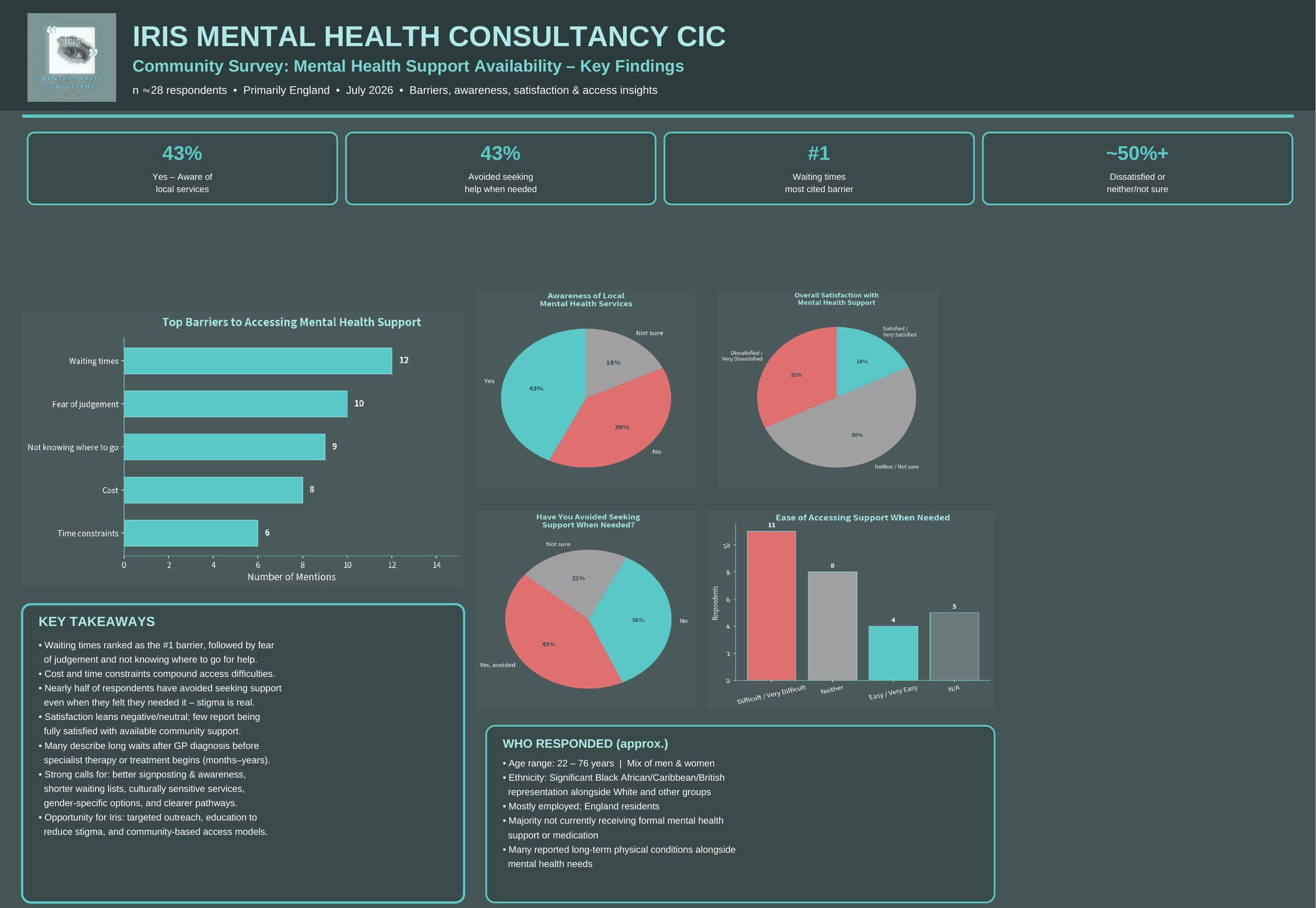
When we asked what stops people getting mental health support, waiting times came up more than anything else. Many people told us about waiting months, sometimes years, between seeing their GP and starting therapy or treatment.

Why it matters: While people wait, things can get harder. Support that comes sooner can stop a difficult time from becoming a crisis.
43%

Nearly half have held back from asking for help.

43% of people said they had avoided seeking support even when they felt they needed it. Fear of being judged was the second most common barrier.

Why it matters: Stigma is still real. People need to know that asking for help is normal, and that they will be listened to without judgement.

43%

Less than half know what’s available locally.

Only 43% of people said they knew about mental health services in their area. Not knowing where to go was the third most common barrier.

Why it matters: Help can only make a difference if people know it exists and how to reach it.

11 of 28

Getting support is hard.

11 people said getting support when they needed it was difficult or very difficult. Only 4 said it was easy. Cost and finding the time made it harder still.

Why it matters: Support has to fit around people’s lives, be affordable, and be simple to start.

18%

Few people are satisfied with the support out there.

Only 18% of people said they were satisfied with the mental health support available. Half weren’t sure, and almost a third were dissatisfied.

Why it matters: There is a clear gap between the support people need and what they feel they can get.

What people asked for

  • Better signposting, so people know where to go
  • Shorter waiting lists
  • Culturally sensitive services
  • Gender-specific options
  • Clearer pathways into support

What this means for Iris CIC

These findings guide how we work. They point us towards reaching out directly to communities, helping to reduce the stigma around asking for help, and offering support based in the community, so people can get help sooner, closer to home and in a way that feels right for them.

The data

The full survey results.

Community survey on mental health support availability. Around 28 respondents, mostly in England, collected in July 2026.

Top barriers to accessing mental health support (number of mentions)
  • Waiting times12
  • Fear of judgement10
  • Not knowing where to go9
  • Cost8
  • Time constraints6
Ease of accessing support when needed (respondents)
  • Difficult / very difficult11
  • Neither8
  • Easy / very easy4
  • Not applicable5
Are you aware of local mental health services?
  • Yes43%
  • No39%
  • Not sure18%
Have you avoided seeking support when you needed it?
  • Yes, I avoided it43%
  • No36%
  • Not sure21%
Overall satisfaction with mental health support
  • Satisfied / very satisfied18%
  • Dissatisfied / very dissatisfied32%
  • Neither / not sure50%

Who responded (approx.)

  • Aged 22 to 76, a mix of men and women.
  • Significant Black African, Caribbean and British representation, alongside White and other groups.
  • Mostly employed and living in England.
  • Most are not currently receiving formal mental health support or medication.
  • Many live with long-term physical conditions alongside their mental health needs.
Iris Mental Health Consultancy CIC community survey key findings poster, July 2026. The results shown in the charts above.
The original survey findings poster.

This is a small community survey, so the findings show what people in our community told us rather than representative national figures.